"Let all your things be done in Love." (1 Corinthians 16:14)
Protected by Copyscape DMCA Copyright Protection

Introduction:

My photo
Current: Danbury, CT, United States
Welcome! A few years ago, I discovered an application that artists employ in their works to bring cultural awareness to their audiences. Having discerned this semiotic theory that applies to literature, music, art, film, and the media, I have devoted the blog,Theory of Iconic Realism to explore this theory. The link to the publisher of my book is below. If you or your university would like a copy of this book for your library or if you would like to review it for a scholarly journal, please contact the Edwin Mellen Press at the link listed below. Looking forward to hearing from you!

Announcements

I will present or have presented research on Sydney Owenson (Lady Morgan) or my semiotic theory of iconic realism at the following location(s):

2026: I will be researching and writing my third book on iconic realism.

November 2025: New England Regional Conference for Irish Studies, Massachusetts College of Liberal Arts, "Sociolinguistic Evidence in James Joyce’s Ulysses: The Use of Language to Express the Semiotic Theory of Iconic Realism"

April 2022: American Conference for Irish Studies, virtual event: (This paper did not discuss Sydney Owenson.) "It’s in the Air: James Joyce’s Demonstration of Cognitive Dissonance through Iconic Realism in His Novel, Ulysses"

October, 2021: Sacred Heart University, Fairfield, CT: "Sydney Owenson’s use of sociolinguistics and iconic realism to defend marginalized communities in 19th century Ireland"

March, 2021: Lenoir-Rhyne University, Hickory, North Carolina: "Sydney Owenson (Lady Morgan): A Nineteenth Century Advocate for Positive Change through Creative Vision"

October, 2019: Elms College, Chicopee, Massachusetts: "A Declaration of Independence: Dissolving Sociolinguistic Borders in the Literature of Sydney Owenson (Lady Morgan)"

31 December, 2025

Winding Down


 Winding Down

As the old year winds down, 
and a new year begins to unfold, 
I think of ways that I can make
positive change in the upcoming days. 
Winding down,
opportunity presents itself in 
the small, seemingly insignificant daily deeds:
making coffee, tea, or other morning drink, 
teaching students unique ways to think,
exercising to keep my body in shape 
by walking, cleaning, or enjoying the landscape,
praying to God to provide me guidance 
then listening to you with your usual brilliance.
Winding down, 
I know this is right 
for positive thoughts enter my mind day and night.
‘tis good to live in this memorable way
for more days, more years will pass
when at last, we greet that spectacular 
‘One day...’

© Jeanne I. Lakatos

You can hear my reading of this by clicking HERE.

26 December, 2025

Ekphrasis: My poem, "Haven" and the Church of St. Stephen the Martyr

Today, December 26, is the Feast of Saint Stephen. 
Below is a photo of the Church of St. Stephen the Martyr in Opotiki, New Zealand. This picture brought to mind the introduction to a collection of short stories that I will complete... one day. The poem accompanying this photo is a conversion of a portion of my prose introduction to poetic form.

Church of St Stephen the Martyr, Opotiki, ca 1910-1930
"Behold, I see heaven open and the Son of man standing at the right hand of God." 
(Acts 7:56) kjv
~ St. Stephen’s words at his theophany

Haven

They beckon 
the weary-hearted and calloused,
“Come and sit with me.”
Rows of empty pews
moor at a small altar,
each one anchored with a kneeler. 

Her candle lit,
she takes her usual seat
in the second row,
hoists the kneeler, 
then quietly moves it
to the wood floor,
genuflects in the Holy Presence, 
and blesses herself.

With eyes lowered,
she steers her troubled vessel
on an ethereal air,
through prayerful sighs
to the Haven of hope,
His Almighty Promise.

© Jeanne I. Lakatos


(My reading of this poem is on Pod-omatic at the bottom of this page.)

25 December, 2025

Christmas Sunset


Christmas Sunset, Danbury, Connecticut


Christmas Sunset

The sun retreats on this Christmas Day, 

as I reflect on: 

Peace

in my soul, praying for all who suffer 

from life's distress to find God's Peace. 

Love

in my heart, praying for those whom I love 

to see how their words have inspired me. 

Joy

in my voice, praying for the world to hear 

the music within and share this song with others.


© Jeanne I. Lakatos

You can hear me recite this poem by clicking HERE. 


24 December, 2025

A Christmas Poem: Sweet Savor

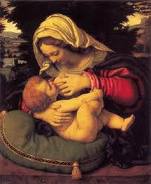
This Christmas poem was written a few years ago after I overheard a woman in the grocery store concerned that she didn't have enough cloves for her hot mulled wine. (Four bottles of cloves weren't enough? Ha! Oh dear...) I think Mary spoke to me personally that day, whispering into my subconscious, "Jeanne, you have to write this.... now!"  Merry Christmas!

Painting by Andrea Solari, ca. 1507

Sweet Savor

What shall I drink? Egg nog or grog?
What did the Holy Family drink
on that holiest night of nights?
Did Mary lean over to Joseph
after giving birth to Jesus and say,
“Joseph, be a dear and pour me
another glass of Chardonnay?”
To which Joseph replied,
“Mary, Darling, all we have is
a little hot mulled wine left over
from the party last night.”

Or…
Did a father, proud
after such a long trip
offer his bride a sip
of water to give her joy
upon delivering this
beautiful, healthy Boy?

Did the baby cry
in a humble home
and look to his mother,
so beautiful and warm,
snuggle up  
to her swollen breast
and drink of the milk
from the Mother Blessed?

© Jeanne I. Lakatos 


To hear my reading of this poem, click HERE.

22 December, 2025

December 22: Feast Day of Saint Frances Xavier Cabrini

 “Work in me, oh adorable Heart of Jesus, because you know well how incapable I am of doing perfectly everything that you want of me." (Saint Frances Xavier Cabrini) 

This saintly woman is important to me because from birth to age 14 years, I attended the Saint Frances Xavier Cabrini Catholic Church in Allen Park, Michigan. I was baptized, attended my First Confession, received First Holy Communion, and Confirmation there. Mother Cabrini has been an important part of my spiritual journey and I am grateful to have learned about her devotion to Jesus Christ from a very young age. 


20 December, 2025

Fourth Week of Advent


As the final week of Advent 2025 arrives, I have concluded my university obligations and finally, I have the time to enjoy the splendor of peace and preparation for the Christmas season and the beginning of a New Year. Although most of the snow has melted, we've had plenty of frigid temperatures and the meteorologists indicate that a bit of snow may be on its way. Therefore, I fill my heart and mind with gratitude for health, love, music and joy in my life as I prepare for this festive end to 2025. 

Wishing you all a blessed Holiday Season!

19 December, 2025

Sweet Dreams (Codladh sámh)

Sweet Dreams

Softly the trees sway
breezes steadily pulsating
plummeting my senses
DEEP DEEp DEep Deep
into a serene, sensual
serenade of sleep
slowly sifting
the sands of 
consciousness
into a sea of dreams
where fantasy releases
the genesis of truth.

Jeanne I. Lakatos 2009

18 December, 2025

"Snow and Wind"

To me, the holiday season includes memories of snow and wind, family gatherings in Michigan, where, no matter how intense the weather, we always gathered at my Grandma's house to celebrate. As an adult, those memories revive with each new 'winter weather advisory,' and, with a lovely fire in the fireplace, all outside hostilities melt away.


Photos taken with my Canon SureShot in Danbury, CT

Snow and Wind

Snow speaks silently,
caresses my heart
with memories,
tickles my soul
with anticipation,
blends with ice
to generate adrenalin
focus.

Howling wind
erases impressions
with its jealous grasp
stings my cheeks
wraps around my bones.
My body shivers
to generate adrenalin
warmth.

Fire beyond the hearth
stoked with trees 
that once shaded, once housed,
once bore sparkling icicles
now draws me into its 
crackling core
to melt adrenalin
dreams.

© Jeanne I. Lakatos

To hear me recite this poem, click HERE

16 December, 2025

Divine Breath

The Holy Trinity  
by Corrado Giaquinto, circa 1754

One morning, I was inspired by the homily of our local priest, 'Fr. Tim.' He was referring to the Holy Spirit and the Hebrew term for spirit: breath. Hence, I penned the following: 

Divine Breath

Enter the Holy chamber; 
kneel before Divinity, 
present on the altar 
in the form of a simple candle.
Surrounded by a feeling of His welcoming Spirit,
a Blessed breath causes one 
to inhale: 
the Cleansing Air of Love and Forgiveness,
to exhale: 
the chaos of hate and compromise.
Over and over, 
this choice is made:
to breathe in the Holy Spirit, 
from His Divine Breath: 
essential to all of humanity, 
the salve that soothes the wounded soul.
Breathe in. 
Breathe out.

© Jeanne Iris Lakatos

To hear my reading of this vers, please click HERE.

14 December, 2025

Sandy Hook Elementary School Tragedy in Newtown, Connecticut

(Photo from Google Images)

On a Friday morning, thirteen years ago, as I sat at my desk, grading final papers, I received word of a shooting in a town nearby. The first news indicated that there were multiple shooters and one or more were unaccounted for. Overhead, helicopters circled the university as ambulances whaled down the street to Danbury Hospital, located two blocks away from my office.

By day's end, this entire area was in mourning, for the beautiful town of Newtown was now in the history books, not as the idyllic southern New England town we all love and cherish around here, but in the same league with Aurora and Columbine, Colorado and scores of other towns over which this cloud of horror has shrouded. As the names became revealed to us, not one person in the area did not have some connection with the victims or their families. We're all in mourning in the Newtown-Danbury area, once given the title as the 'Safest town in the State.'

No further words will come to me. Please pray for peace, understanding and the power of love this holiday season.

Blessings,
Dr. Jeanne Iris

13 December, 2025

Memorial of Saint Lucia (Lucy): December 13


Painting by Francesco del Cossa, circa 1474

The Story of Saint Lucia (Lucy)
from: 
 https://www.stlucy-campbell.org/about-staint-lucy/

December 13th is our patron saint’s feast day! Saint Lucy (Santa Lucia) was a young virgin martyr in Syracuse, Sicily (Italy) in the late 200s A.D. who was put to death in 304 A.D. Excavation in Syracuse revealed a tomb dating to the 4th century with an inscription that it belonged to St. Lucy (her relics were removed hundreds of years after her death and are believed to currently be in Venice, Italy). Beyond this, little factual information is known about St. Lucy. Her name, Lucia in Italian, is believed to be derived from the Latin Lux, a term for “light.” The earliest known written information about St. Lucy’s story is from the late 400s, Acts of the Martyrs, which indicates there was already veneration shown to her by that time. By the 6th century, legends about St. Lucy had spread throughout Italy and other parts of Europe. Although the stories vary somewhat, the common theme in all of them is that St. Lucy dedicated herself to Christ and to serving the poor, which angered the pagan to whom she was betrothed. He denounced her as a Christian to the authorities, who then attempted first to drag her to a house of prostitution and then, when they could not physically move her, to burn her – which was also a failure. Ultimately, they ended St. Lucy’s life with a dagger or sword to her throat.

St. Lucy’s legend holds that her eyes were gauged out and God then provided her with new eyes. This came about, it is said, because her pagan suitor loved her beautiful eyes. In some versions of this story, St. Lucy plucked out her eyes herself and gave them to her suitor; in other versions, her eyes were removed by her persecutors. St. Lucy is often depicted holding a small plate with two eyes on it. She is the patron saint of the blind.

Legend has it that St. Lucy delivered wheat and bread to the poor and homebound, and possibly to Christians staying in the catacombs, often in the darkness of night to avoid detection. She would carry a lamp or wear a crown of candles (to free her hands for carrying food) to light her way. Because of this, the lamp and wreath of candles are symbols of St. Lucy. Hence the lamp that has long been a symbol of our parish.

According to legends of the Middle Ages in a couple different locations in Italy, including Sicily, ships filled with wheat came into harbors on St. Lucy’s feast day, saving the people from a famine. A Sicilian tradition based on this legend is to make a soup and a dessert with wheat berries on St. Lucy’s feast day. In Croatia, Christmas wheat is planted in a pot (indoors) on St. Lucy’s feast day. By Christmas Eve, the wheat shoots have emerged and the wheat is placed next to the manger scene as a gift to Jesus and a reminder for us that God feeds our souls with the Eucharist and our bodies with wheat.

Likewise, according to Scandinavian legend of the Middle Ages, during a terrible famine in southern Sweden and on the darkest day of the year, people saw a boat sailing across Lake Vannern. St. Lucia was at its prow, dressed in white and glowing with an unearthly light. When the boat came to the shore, she handed out enough sacks of wheat for the people to have bread through the winter. Scandinavian St. Lucia traditions include making “Lussekatter,” a slightly sweet saffron breakfast bread shaped in specific ways, and visiting the poor, sick, or homebound to serve the Lussekatter with coffee and to sing the Santa Lucia song.

There are many other traditions associated with St. Lucy in various cultures that were brought to the Americas and are still celebrated today, from the East Coast (Society of St. Lucy of Syracuse in Hartford, CT) to the Midwest (Sicilian Italian-based St. Lucy festival in Omaha, NE) to the West Coast (Scandinavian Santa Lucia service and celebration at St. John’s Lutheran Church in Sacramento, CA).   All the traditions incorporate symbolic meaning of St. Lucy as the bearer of Christ’s light in the darkness of winter from her feast day (Dec. 13) until His birth at Christmas.

While it may be hard to distinguish fact from legend surrounding our patron saint, one thing is certain: This 3rd century Christian dedicated her life to Christ and to serving others and is an example to us for how we can use our time, talents, and treasure to carry the light of Christ to others in their time of need.

“To God’s servants the right words will not be wanting, for the Holy Spirit speaks in us. . . All who live piously and chastely are temples of the Holy Spirit.” –Attributed to St. Lucy


12 December, 2025

Harmony of the Spheres


The following is an excerpt from a paper I presented at the Mid-Atlantic Conference for Irish Studies, years ago. I've placed information  about this same topic on my other blog, which can be reached by clicking on the photo to the right.  

Human beings have an inherent need to interact with one another. Yet, they often find themselves struggling with what appears to be the truth of their perceptions. This ambivalence leads to the categorizing of experiences as a way to manage personal reactions. Philosophers, such as Immanuel Kant and Carl Jung, as well as mathematicians, such as Pythagoras and Kepler, have clarified this management in terms of music, more specifically, the music of the spheres.

This concept illustrates that human communication parallels strict mathematical components associated with harmonics. To clarify the concept of harmony of the spheres, one can consider a musical tone that contains the original resonating frequency with overtones creating precise harmonic variations.

Pythagoras’ theory contained the idea that there was a distinct mathematical configuration, establishing a relationship of the harmonic distances between the planets. These harmonics were considered the substance of a planetary influence on the human psyche.

Centuries later, Johannes Kepler clarified this theory with his discovery that harmonic energy emanates from the sun, and there exists an exact harmonic relationship between each planet. Philosophers of the eighteenth century, such as Immanuel Kant, connect Kepler’s theory to the concept of human consciousness.

Thus, music of the spheres represents the harmonics of human thought whereby one idea, emanating from a human being, extends to another throughout the centuries, and overtones or nuances of thought create a new harmonic of the original conception. This new harmonic, then, resonates with another interpretation, and soon, there are many new concepts formed that connect with the original resonating thought.